

An important part of the Central America EUDR Learning Community is sharing experiences and learning from others in the coffee supply chain. As such, during a group meeting, Michael von Luehrte spoke on behalf of the Brazilian Coffee Exporters Council (CECAFÉ) – an organisation that represents 126 members responsible for 96% of national coffee exports to more than 150 countries. He shared how the world’s largest coffee producer is using a combination of sustainability policy, traceability systems, and public–private collaboration to meet the new requirements.
For decades, Brazil has been developing systems for sustainability and traceability in agriculture, giving it a strong foundation to adapt to the EUDR. This long-term focus on data, regulation, and transparency has helped position the country as one of the best prepared globally to meet the new EU standards. Although, of course there are still some challenges.
The scale of coffee production in Brazil
Brazil is the world’s largest producer and exporter of coffee. During the session, data was shared from the Brazilian Agricultural Census.
Brazil has 36 coffee-producing regions that offer a diversity of origins, flavours, and qualities. The country counts around 265,000 coffee farmers, 72% of whom cultivate less than 20 hectares – demonstrating the dominance of small and medium producers in the country.
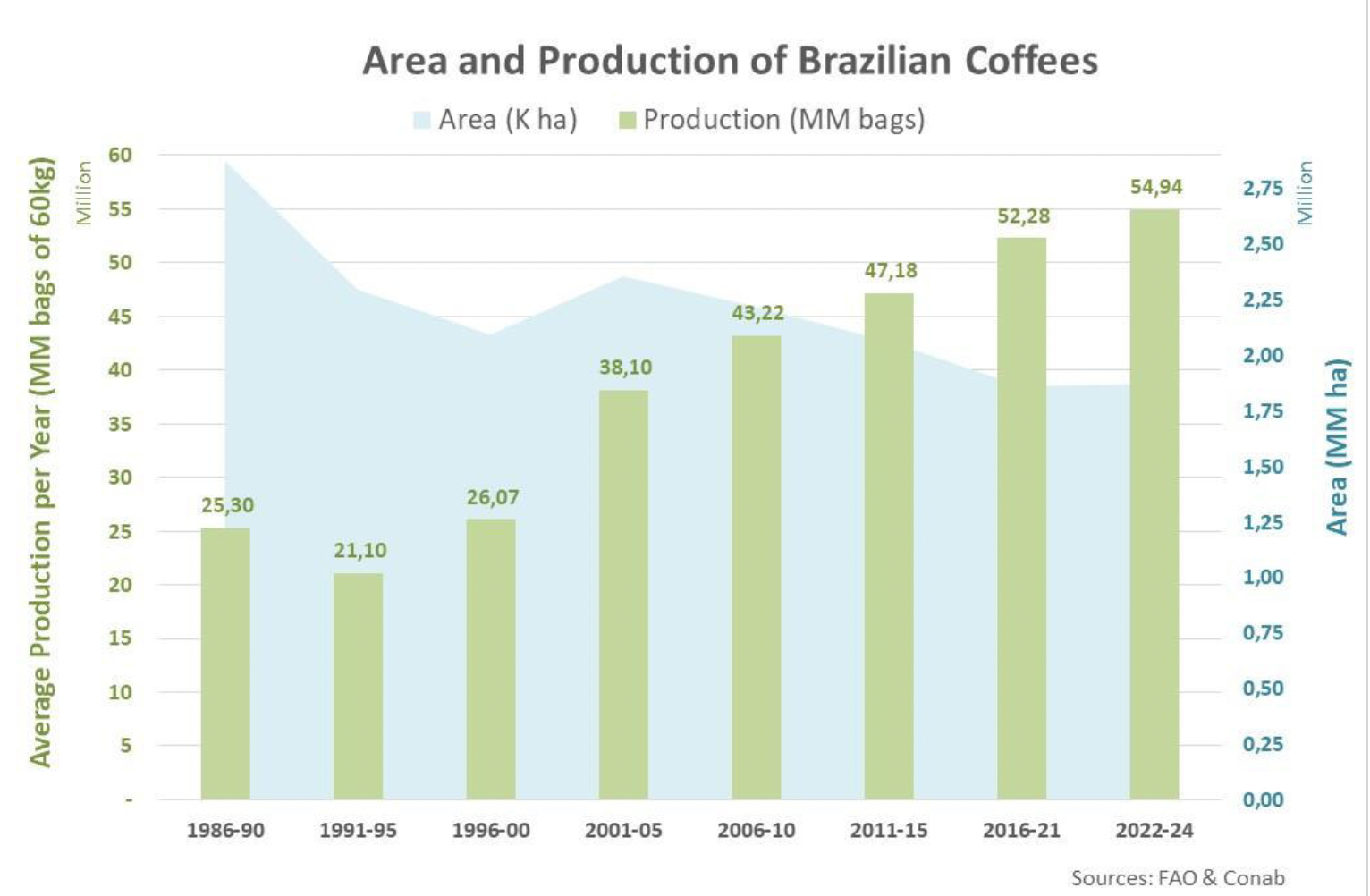
The presentation explained how, over the past decades, Brazil has achieved a 55% reduction in coffee area alongside a more than 400% increase in productivity, which is attributed to innovation, technology adoption, and good agricultural practices. In the 2023-24 crop year, exports reached a record 47.3 million 60-kg bags, with 47% of exports (23.6 million bags) exported to the European Union. This makes the EU a priority export destination and highlighting the importance of Brazil being ready for the EUDR to come into force.
Brazil’s environmental governance
Brazil’s environmental framework is anchored in the Forest Code which is a law that was introduced in 2012 that requires all rural properties to maintain a Legal Reserve and Areas of Permanent Protection (APPs). The law sets limits on land use, protects native vegetation, and establishes mechanisms to control and penalise illegal deforestation.
The Rural Environmental Registry (CAR), is the national, public, and mandatory electronic registry for all rural properties that plays a key role in supporting this system. It is the federal government’s main tool for monitoring compliance with environmental legislation and provides the foundation for the country’s land-use data.
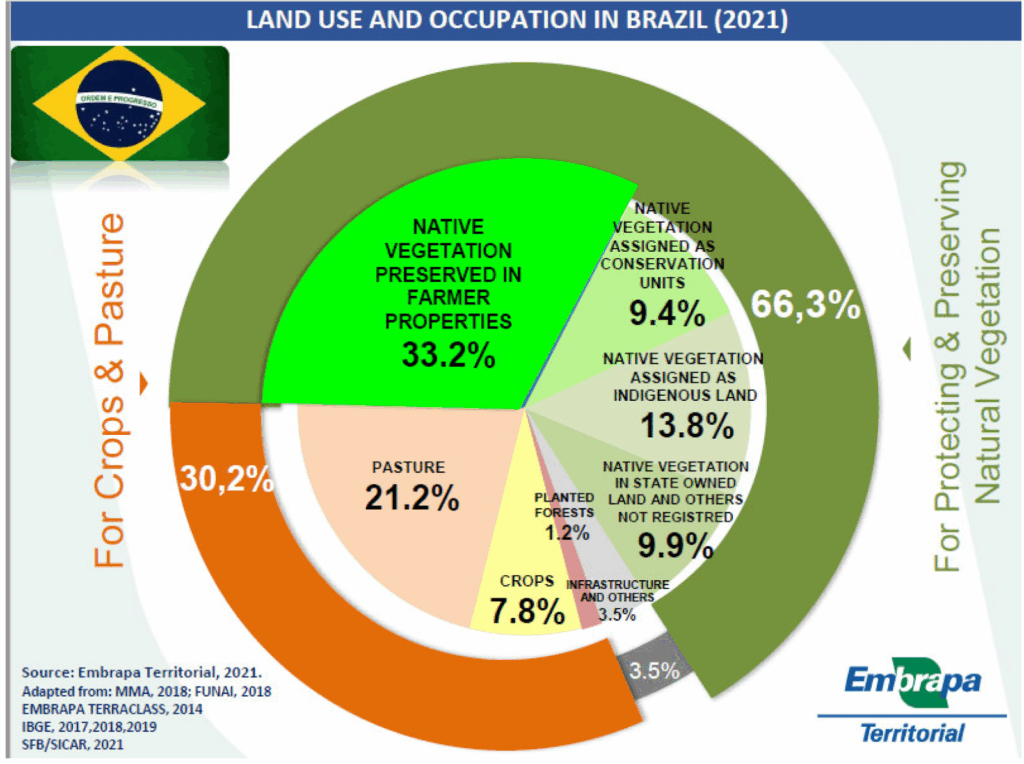
For example, the data shows that today, 66.3% (564 million hectares) of Brazil’s national territory remains covered by native vegetation. That area is equivalent to the combined surface of 48 European countries. In Minas Gerais alone, protected areas in coffee-producing regions cover 51,500 km², roughly 1.25 times the size of Switzerland.
Focusing on productivity
Efficiency is an economic goal, especially to help farmers improve their income. However, efficiency is also an important component of sustainability strategies. Favourable farmer margins and income allow for better compliance with ESG requirements.
With improved practices, coffee cultivation in Brazil can remove around 10.5 tonnes of CO₂ equivalent per hectare each year. Coffee producing regions such as Minas Gerais and Espírito Santo illustrate how productivity and preservation can coexist.
In Minas Gerais, coffee is grown on properties that include 9.47 million hectares of preserved native vegetation. Through the SeloVerde MG platform, developed by the Federal University of Minas Gerais (UFMG) and the State Forestry Institute (IEF), more than 115,000 properties have been assessed since 2008, with no recorded deforestation violations. Espírito Santo shows similar progress, with nearly one million hectares of preserved native vegetation across its coffee-growing municipalities.
Traceability through technology and collaboration
The Brazilian Coffee Exporters Council leads the sector’s sustainability and traceability agenda, including the development of the Brazilian Coffee Platform, a system that monitors over 250,000 coffee farmers using georeferenced and satellite data.
The platform integrates information from public databases such as the CAR, enabling real-time analysis of land use, deforestation alerts, and ESG indicators. It also features an alert and risk management system: if a farmer is linked to deforestation or appears on a restricted list, the platform automatically flags it.
On average 71,000 containers of coffee are exported to the EU each year. Each container includes beans from multiple farmers with an average of 150 different producers per container. That means advanced systems are required to ensure transparency across complex supply chains.
Preparing for EUDR implementation
Brazil exports all seven commodities covered by the EU Deforestation Regulation (EUDR): coffee, soy, cattle, cocoa, palm oil, wood, and rubber. To coordinate compliance efforts, the Brazilian government established a national EUDR Task Force, led by the Ministry of Foreign Affairs (MRE), with CECAFÉ representing the coffee sector.
The Brazilian Coffees Traceability Platform, which currently covers 98% of coffee exports to the EU, plays a central role in this process. It has 52 members, including cooperatives and international companies, who are working together under an EUDR Multi-Sector Protocol to align data systems, strengthen monitoring, and improve traceability.
CECAFÉ has several key priorities for Brazil’s coffee sector and preparing for the EUDR. These include:
- Open dialogue with EU Competent Authorities.
- Defining what constitutes “insignificant deforestation risk.”
- Improving importer due diligence systems.
- Ensuring EU recognition of Brazil’s national databases and public systems as sources of information.
- Using regional deforestation risk assessments rather than country-level benchmarks.
- Addressing inaccuracies in existing EU forest cover maps.
- Managing the additional costs associated with traceability and logistical challenges that come from segregation.
Looking ahead
Brazil’s experience shows how strong environmental laws, technological innovation, and coordinated governance can underpin sustainable coffee production at scale. Most coffee-producing countries don’t compare with the size and scale of Brazil’s sector where collaboration and investment come from across the entire value chain.
However, there are still valuable lessons for other producing countries in how Brazil is preparing for the EUDR, particularly in its long-term commitment to traceability, data systems, and cross-sector coordination. As EUDR implementation advances, the challenge lies in ensuring that data-driven transparency supports smallholder participation and long-term resilience in the global coffee trade.
For more documents and resources on how different actors in the coffee supply chain are preparing for EUDR, click here.