

Advances in EUDR: Lessons from Colombia
As part of the Central America EUDR Learning Community, members met to hear directly from representatives of the coffee sectors in Colombia. The session explored how the country is advancing in its adaptation to the requirements of the EU Deforestation Regulation (EUDR) and what lessons can be drawn for other producing regions.
Colombia’s progress: building a deforestation-free coffee sector
Marcela Gaviria Botero, Director of Analysis and Projects at the National Federation of Coffee Growers (FNC), shared Colombia’s approach to aligning its coffee production with EUDR standards.
Colombia has 552,814 coffee producers across the country. More than half of these, 296,400 producers, are small-scale producers that cultivate less than one hectare of land, making the country’s adaptation to the EUDR complex and essential. Around 40% of Colombia’s coffee exports are destined for the European Union, making compliance with the regulation essential to maintaining market access.
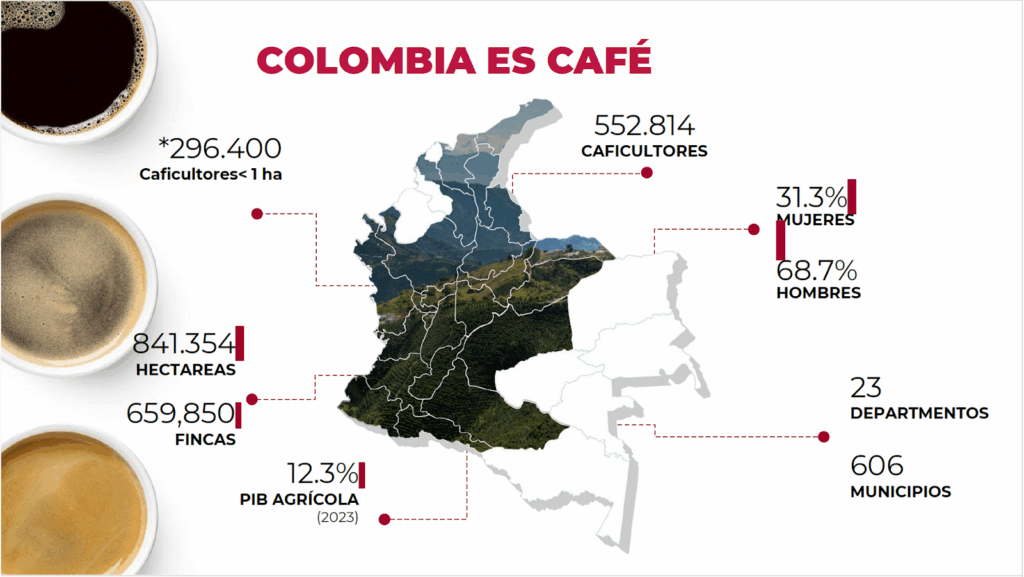
To ensure Colombian coffee continues reaching the European market, the FNC has developed a comprehensive strategy aligned with the EU Green Deal. The goal is to demonstrate that Colombian coffee is deforestation-free, while ensuring that adaptation costs do not fall on smallholder families who make up 97% of Colombia’s coffee-growing population. The strategy is designed to:
- Ensure the continued delivery of Colombian coffee to European and other markets without restrictions, and
- Avoid imposing additional costs on smallholders by leveraging public and official information systems.
Deforestation-free commitment
A key pillar of Colombia’s strategy is the georeferencing of production lots, integrated through the SICA (Coffee Information System) platform used by exporters. This digital tool allows traceability of coffee plots and includes data such as grower name, farm location, cultivation area, and official codes from the National Administrative Department of Statistics (Departamento Administrativo Nacional de Estadística or DANE) for each department and municipality.
- 100% of production data is now georeferenced in SICA.
- For lots larger than 4 hectares, polygon coordinates are provided.
- Data also indicates whether the lot was established before the EUDR baseline date.
This effort is supported by an agreement between the FNC and the Unidad de Planificación Rural Agropecuaria (UPRA), Colombia’s Rural and Agricultural Planning Unit, which ensures the secure and confidential use of producer data and aims to achieve 100% coverage of coffee producers.
Risk analyses indicate that 87% of registered farms have verifiable establishment dates, helping demonstrate compliance with the EUDR’s deforestation-free requirement.
Data protection and collaboration
The Habeas Data framework ensures that producer data is collected, managed, and shared in line with Colombian law. So far, 72% of growers have completed data consent registration.
To strengthen monitoring capacity, the FNC has partnered with the Instituto de Hidrología, Meteorología y Estudios Ambientales (IDEAM), Colombia’s Institute of Hydrology, Meteorology, and Environmental Studies, to define deforestation-free coffee zones, beginning with an EU-supported pilot in Huila, a region in southwestern Colombia. The sector is also using tools such as Global Forest Watch for land-use change analysis and providing training for exporters and technical staff.
So far,
- 30,000 coffee growers have been informed about EUDR compliance to date.
- Four national training sessions have been held for the FNC’s Extension Service.
- An ABC guide has been developed for extension workers and rural development promoters to facilitate communication with farmers.
Legal compliance
To legally demonstrate EUDR compliance, Colombia’s approach encompasses environmental protection alongside human rights protections, including land use rights, third-party rights, labour, and indigenous community rights. It also integrates broader regulations related to taxation, anti-corruption, customs, and trade.
Collaboration with national and international partners such as Ministerio de Agricultura y Desarrollo Rural (MADR), which is Colombia’s Ministry of Agriculture and Rural Development, the EU, EFI, and Swisscontact has been central. Together, they are updating the coffee-growing zone data and improving risk assessment and legal reference tools for exporters to Europe.
There is also a big focus on due diligence to ensure that all documentation, traceability systems, and verification processes are aligned for exports to the European Union.
Next steps
Looking ahead, the coffee sector in Colombia has identified key priorities for continued progress:
- Establishing technical tables to ensure coordination and information flow between government, industry, exporters, and producers.
- Developing a single, consistent message for coffee producers to avoid confusion and support compliance across the value chain.
For more documents and resources on how different actors in the coffee supply chain are preparing for EUDR, click here.